Tuesday, July 21, 2009

Mantas in the Morning


Since we last wrote we've had a few adventures. That afternoon we had a kayaking lesson with one of the owners of the island, Grant. They require any guest who wants to use the kayaks to go through the lesson. It was quite fun, and both of us were surprised at how much goes into keeping a kayak right side up.
That night, we had a great dinner, as usual, and we were settling in for the night when we realized we'd forgotten to get a bottle of water for the night. The sniffles I'd had earlier in the day had developed into a full-blown cold, and I was had a bit of the "medicine head" that comes with taking sudafed, but I offerred to go back to the lodge. I blame the medicine-head for what happened next.
I was nearly to the lodge, and I could see the light from the dining room, so I turned off my headlamp. I was looking up and forgot about the short concrete step right there. I kicked it full force with my bare big toe on my left foot. There was a loud pop and I stumbled. I looked down and saw my toe covered with blood.
I asked Jill and her son, Jason, to patch me up. Luckily I didn't break the toe, but I did burst a blood vessel and crack the nail. I was mostly pissed because we were supposed to go on the day-long diving trip the next day which included a couple of WWII plane wrecks. Because of my toe, we didn't go. Instead, I grumbled and limped my way around the island (I'm a bit of a baby when I'm sick or hurt, as Anna can tell you, and I was both). We settled for some kayaking and an afternoon dive with Jill just off the dive Jetty. One of the things that makes Uepi so great is that you can literally jump off the dock and have a wonderful dive right there.
I then went fishing with Jason, and the assistant manager, Josh. We didn't catch anything more than a couple of beers and some good conversation, but overall, it was not a half-bad way to spend an evening.


(Relaxing on the Welcome Jetty)

The following morning we got a chance to do something I've wanted to do since I first saw NOVA's ocean specials on TV as a kid. We got to swim with large Manta Rays.
We got up a little early, and one of the dive guides, Robert, took us out on the lagoon to look for the mantas. We searched for a long time. It started to rain, and we were beginning to lose hope, when Robert spotted something. We got a bit closer, and there, a large fin broke the surface. There were two of them, and they swam by right next to the boat. The large one dwarfed the boat as it went by. It couldn't have been less than 15 feet wide. They disappeared for a bit as they continued to search for food, then we found them again. A group was feeding in one spot, doing loop-de-loops through the krill. You could see their white bellies flashing in the water.
Robert told us to jump in, and at first, I was a little nervous, but after a moment, I thought, what the hell? I put on my flippers, mask and snorkel and rolled off the side of the boat, Anna shortly behind.
We slowly swam up to them. They were beautiful. There was 7 or 8 of them, rolling under the surface and flapping their fins like birds. They swam right under us, and we could see them looking up and checking us out. They swept back and forth a few times before veering off as another group of 5 or 6 came in. I dove under a few times to try and touch them, but I never got close. The mantas can be playful, but they are still wary.
After a while, it started raining harder and it was time to go in. It was a short time in the water, only about 10 minutes, but that is 10 minutes that neither Anna or I will ever forget.

The day after I did something you might consider a lot of fun, or just plain stupid. I got in the water with several other people to watch Grant throw fish guts into off the welcome jetty to the resident sharks. The resulting feeding frenzy was astonishing. Anna watched from the jetty and got some good pictures. There were seven of us in the water, hiding under the jetty. We had strict orders from Grant to no stick so much as a finger out from under the jetty until he said so.

We all were wearing our snorkels and had a good view of the action. When Grant started chucking fishbait into the water, the sharks went nuts. They darted to and fro bumping into each other and trying to reach the food. I know now why they call it a feeding frenzy. However, even though it was frenetic and chaotic, it was a controled chaos. You could see that the sharks knew what was going on. Grant was alternating his throws left and right, and when it was clear that some sharks would not get anything if they swam over, they stayed put and waited for the next throw to come their way. The sharks had learned. That is not something one normally associates with sharks, but it was clear. I was impressed.

Several times one of the sharks would come streaking toward us, only to veer away at the last second when they realized we had nothing to offer. I was also impressed at how quickly the sharks calmed down after it was over. We were able to swim out through them to the stairs without them paying us any more attention than they normally did. We could tell that the sharks knew what was going on. It was great fun, and I came out with all limbs intact.


We continued diving and enjoying the weather over the next few days. Sunday was our last diving day and we were sad we'd missed out on the wreck dives, so we asked to just go over to the planes. They are (appropriately) in the water just off the runway at Seghe, where we had landed. The first one was a WWII bomber in about 15 meters of water. It is a little eerie going down. Because of the current, the water is very murky, and visibility is about ten feet. We got to the bottom and this large shape loomed in the murk like some old ghost. I had never dived on a wreck before, and while it was very cool, it was also a little eerie. Here was where someone was shot down over sixty years ago. The plane is resting upside down, and you could see that a bomb is still attached to the underside of the plane.
The second plane was a fighter, as indicated by the machine gun barrel sticking out the nose. Its two prop engines rest one to a wing, and the tail is open and connects the two engines behind the cockpit. The props are bent where the plane hit the water. This plane landed right side up, and you can get in the cockpit (it's a bit of a squeeze) and see what the perspective was like from there, and feel the controls. There is something about seeing history right there in your face that is both exciting, and humbling.
The plane itself was also covered in a heap of growth, including a big anenome that hosts a very large Tomato Clown Fish. They're pretty cute.


The last day we just relaxed. A little snorkeling in the morning, and the rest of the day with our books. Above, you can see one of the island's other residents, a monitor lizard. There are tons of them. There's also several species of parrots and bats.

This morning, we began undoing what we did to get there. Jill and Grant saw us off at the dock (we will miss them) and off we went in the boat to catch the plane at Seghe to Honiara, amd then on to Brisbane. Above, you can see the edge of the dirt runway at Seghe just behind me. You can see how small the plane was that we took from Seghe to Honiara. It could only fit six people, and there were eight of us waiting. Luckily, we were able to get two seats. Two other guys had to wait for the next plane.

From Mt. Koya, we took six trains, three planes and one boat to get to Uepi, and we would do it all again. Uepi allowed us to relax and unplug from the world. It was a nice interlude on this long trip, and it is a little tough getting back into the rythym of travel. But, as they say, 'the road goes ever on and on'. - Scott

Thursday, July 16, 2009

Anyone for a Swim?


GeoTagged, [N34.73245, W135.48831]

So Anna told you about the trip here, I want to tell you about the diving. Aside from being the only thing we've done here besides eat and relax, it is spectacular. On our way here Anna said that the diving here puts the Carribean (the only other place I've been diving) to shame. I didn't really know what she meant until we got here.

Nearly all of the dives here are wall dives, meaning that you descend down a sheer wall of rock that begins near the surface and drops for hundreds, or sometimes thousands of feet into the blue. On our first day we did Landoro Gardens and Uepi point. The Gardens were beautiful as every square inch of wall was covered with coral, fish and anemones that jostle each other for space.
Uepi point was interesting because you start at the edge of a large channel between two islands and grab on to a piece of rock so you don't get swept away by the current. At about 70 feet deep you can see large fish and sharks as they come out of the deep. Some of the Black Tipped reef sharks were over 6 feet long, but they never really came close to us, then. After a while we let go of the rock and let the current take us back to the dock.
The highlight of the trip so far came on the second day we were here. We were diving off off Elbow point, and as we descended down to 100 feet the shadow of a shark came out of the gloom. At first I just thought that it was just another reef shark, though a big one. Then I saw the head and realized it was a Great Hammerhead shark. It was only there for a moment and then disappeared. A couple of minutes later Anna was trying to signal something to me. My back was to the wall and she was facing me. Then behind her came the same shape, but much closer. I pointed behind Anna and we both watched as the Great Hammerhead cruised by about 20 feet away. We guess that it was somewhere between 10 - 12 feet long, and it was very beautiful. It strangely shaped head swung back and forth as it disappeared one more time into the depths.
That afternoon we took a break from diving and went snorkeling off the dock instead. Just off the dock is another drop-off and we floated above the reef checking out the cool fish and corals. Then Anna looked up and said, "Did you see that shark?". I hadn't, but I wasn't too worried. There are sharks all around the island, and they normally kept to themselves except for some curious glances. But then I started seeing them. There were two Black Tips and they were larger than average, about six or seven feet, and they kept swimming by and darting off. Each time they passed they would get closer and more curious. Finally, Anna looked at me (it was just the two of us) and said "Why don't we get out". We quickly got out of the water, and I thought our snorkeling was done. We went over to the Welcome jetty in front of the lodge, looking to see if we could snorkel there. The water was full of sharks, as you can see above. There was ten or twelve that we could see, all circling and obviously hunting the local fish.
Anna wanted to get in anyway, and I told her she was crazy. Let's jump into a mass of hunting sharks and see what happens. I was not about to do it.
Anna tried to reassure me and said "Look, I bet if I throw this seed pod into the water, they'll all scatter". She tossed the seed pod, about the size of a gold ball, into the water, and every shark in the area came rushing up and snapped at it. I looked at her and said "yeah, right!".

She then wanted to go back over to the dock. We went over there and there were more people snorkeling who'd just gotten back from a dive. We told them about the sharks and their response was "Cool! Let's go see!". Anna said there was safety in numbers and got in the water and began swimming after the others toward the welcome jetty. I thought everyone had lost their minds, but I couldn't let Anna get in the water on her own, so I followed.
Sure enough, we got over there and the sharks were still there. They made room for us though, and even though they were close (I could've reached out and touched several of them) they never acted aggressively, and no one was hurt.
After my initial worries went away, I began to enjoy it. The sharks were amazing, and they were everywhere. Every way we looked, they filled our vision. I tried to count them, but I lost track at twenty. It is wonderful to watch how graceful they are in the water and how inquisitive. As they swam by you could see them checking us out and the wheels turning in their heads as they tried to sort out what we were and if we were a threat.
After a while we went back to the dock. On the way back one of the sharks broke off from the group and swam next to us for several metres. It was great fun. I'm glad I got back in the water.
Since then we've seen some wonderful things including huge Humphead Wrasses, White Tipped Reef sharks, Eagle Rays, and one very playful Sea Turtle who our dive guide played with and spun around in the water.

This afternoon we are doing some kayaking after a backgammon tournament (we call this formation "more bars in more places"). Then tomorrow we are going to dive on some wrecks including a couple of WWII planes, and a tuna boat that is sitting on it's stern on a wall. I won't let the fact that I've come down with a bit of a cold stop me. Anna may be right. If there is a paradise on Earth, this may be it. - Scott

Sunday, July 12, 2009

Journey to Uepi Island


It took us 36 hours of straight travel by train, plane, and boat to reach Uepi. First, we had to undo everything we did to get to Koyasan, after the 6 am service. We went down the cable car, took several trains, then switched to the subway before boarding the bullet train to Tokyo airport. This probably sounds more complicated than it is. Although there are a lot of train connections, the path to Koyasan is well traveled - you are given a list of transfers and the trains are all timed so that you don't stand around waiting. It just took a long time to complete the circuit back to Tokyo. You can see the bullet train we took back to Tokyo below, there is a reason they call it a bullet train, that is one of the fastest rides either of us has ever taken on land.


Then we had a 9 hour overnight flight from Tokyo to Brisbane, Australia. From there you take a plane to Honiara, the capital of the Solomon Islands. (For those of you interested in history, Honiara Airport is the site of the airstrip that was fought over so viciously between Japan and the U.S. During WWII. The name of the island then was Guadacanal. - Scott).


Customs was cleared, then we had to drag our baggage 10 minutes down a dirt road to a small tin shed to make the connection to Seghe Island. The plane was a very small bush plane with 20 seats (see above). After dropping some people off at Gatoke Island, we landed on a short grass strip at Seghe. The island basically contains a grass runway, a boat dock and tin hut, and that's it. The runway is surrounded by the ocean just feet from either end. This makes for an interesting landing. Finally, we took a 30 minute speed boat trip with several other couples to reach Uepi Island.


Uepi is a very small island; it really only contains the resort, which consists of a large gazebo containing the bar and dining room, a small dive shop, boat docks, and individual guest bungalows. The rest of the island is jungle, which can be easily walked via trails. They offer kayaking, diving, snorkeling, hiking, volleyball, crab sighting walks, manta ray snorkels, shark feeds, and day trips to a local village. Anything you could want in a tropical vacation. (There is also a reptile population here. You can see the Solomon Island Boa that was on the path in front of our bungalow the first night. The picture isn't great, he was a bright red, and kinda cute. - Scott)

It was very strange coming back here. I took a tropical marine biology course 7 years ago during college that took place both here and in Fiji. The palm trees and ocean views are just as I remember them. The resort and it's welcoming owners, Jill and Grant, look almost exactly the same, if a bit older. I tell people all the time how wonderful Uepi is, and I don't quite know what it is about this place that makes it so much better than everywhere else. The diving and scenery are spectacular and the food is of gourmet quality. We will see how the diving in the Great Barrier Reef compares to Uepi in a week, when we go to Australia. I suspect Uepi will still be the best. I will let Scott describe the diving to you, since he sees it with the fresh eyes of a new diver. All I can say about Uepi is that it is a hidden paradise that is well worth the journey. -Anna

Saturday, July 11, 2009

Koyasan - Home of Shingon Buddhism


Welcome to Koyasan. This town, nestled at the top of Mt. Koya between eight different peaks, has the largest concentration of Buddhist temples in Japan, over seventy in all. The peaks at the top of the mountain form the shape of a lotus flower, one of the major symbols of Buddhism. In 819 AD, a monk named Kobo Daishi Kukai came here to build a temple. His goal was to create a place away from society where Buddhists could come and meditate in peace without the distractions of the material world. He built the temple complex of Dai Garan. After he passed "into eternal meditation" his disciples finished construction of the complex, and others came and began building other temples. Soon local people began bringing produce and other goods up to the monks, until it became the town present here today.

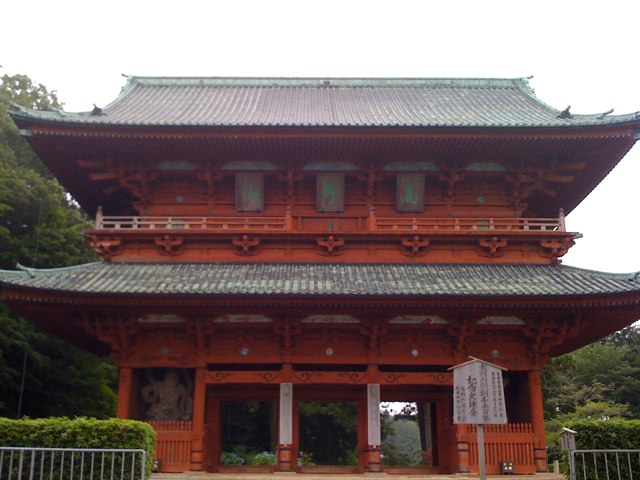
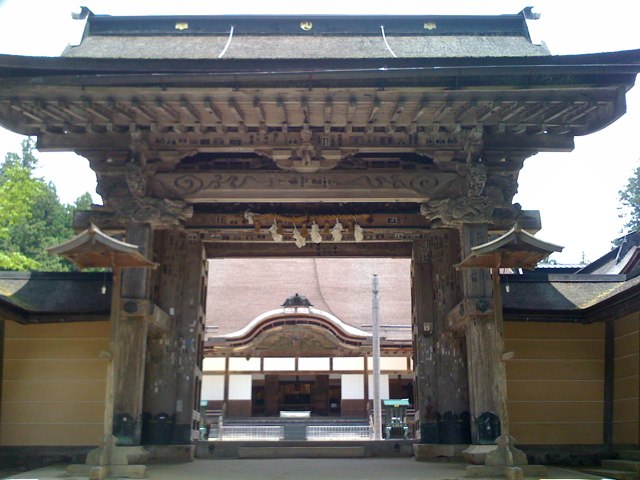
Above you can see the old Gate to the town. It is a tall structure with two guardian statues built into it. It sits at the beginning of town and the main road that passes most of the sites.

We came to Koya by train from Kyoto. The last stop is at the base of the mountain and you have to take a cable car on rails to get to the top. Because the car was technically on the ground, Anna was less nervous, but I was a bit concerned. The slope was close to 60 degrees and it seemed like the car should have just slid back down the mountain. That didn't happen and we made it up to the top without incident.

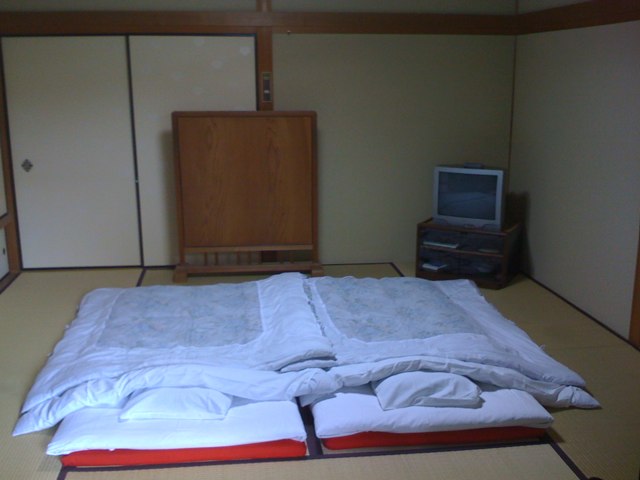
We took the bus into town and arrived at the temple we were staying at, Shojoshinin. We traded our shoes for slippers (shoes are not allowed in any temple) and were shown our room. The room was very similar to the room we had at the Roykan, tatami mat floors and a thin mattress. We had a better view though, and a small balcony that overlooked the temple garden.


We had some time before dinner so we decided to walk around and see what was near. On our way out, Anna was walking behind me. As I passed through a doorway, I heard a strangled cry behind me and I turned to seen Anna standing in the hall with a worried look on her face. She was pointing into a room off the hall. I went back to see what was wrong, and inside the room, on one of the sliding rice paper doors was a spider the size of my hand. We had sent the majority of our luggage on to the airport from Kyoto, and we didn't have our bug net with us. We looked at each orher and we both knew that we weren't going to sleep very well that night.


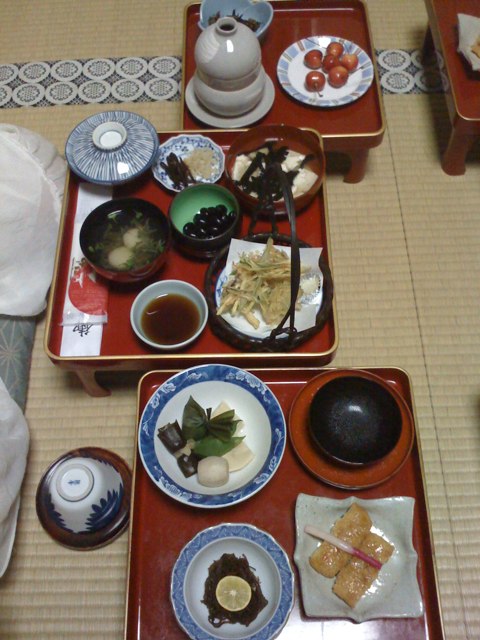
We walked around for a bit and then returned to the temple for dinner. Dinner is always at 5:30 sharp. We went down, sat on cushions and enjoyed a completely vegetarian meal of rice, steamed vegetables, miso soup, some kind of rice ball wrapped in seaweed, and tea. It was better than the dinner at the Roykan, but there were still a few things neither of us really wanted to touch. I have found that I really do not have much interest in eating seaweed. It's too wet and slimy for me to choke down. Also, tofu is not really in my top foods list, though Anna seems to have aquired a taste for it. The biggest problem I had was that the room in which we ate dinner (and breakfast) was on the other side of the wall from where we saw the spider. We never saw it again, but I was continually checking corners.
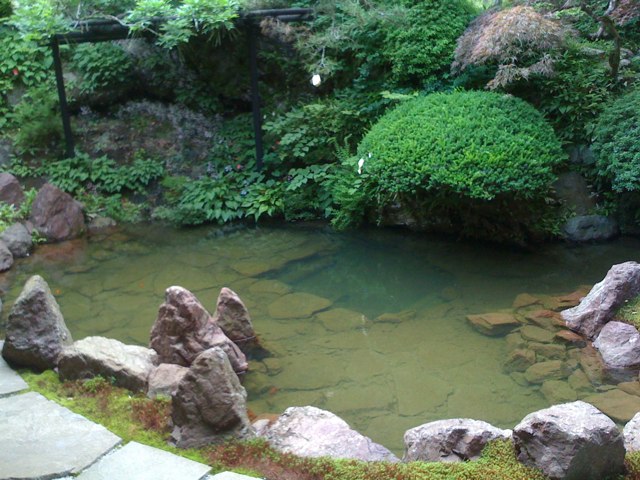
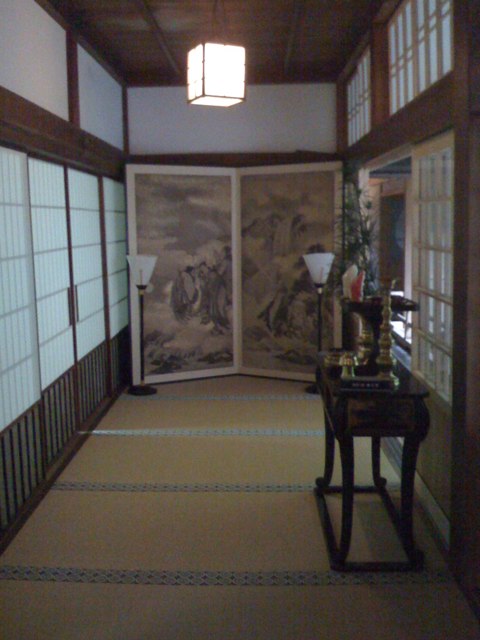
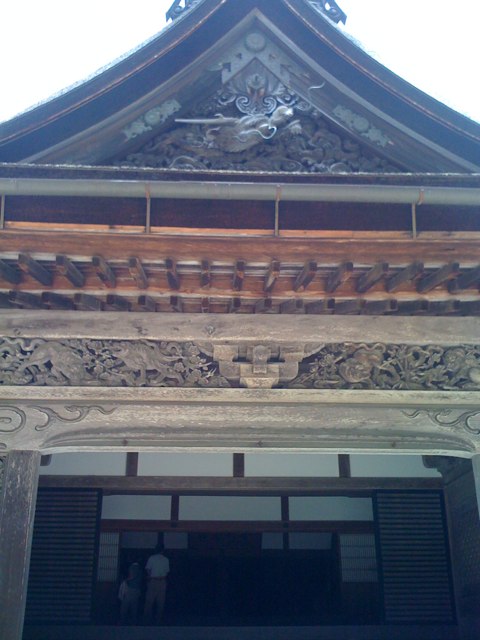
Below are some pictures of the Temple grounds. It is a beautiful and serene place. Aside from monstrous spiders, it is a great place to relax.

This is the pond in the back of the temple. There is a colony of newts living in it that were fun to watch.

One of the back hallways.


Our bed. Simple, but not uncomfortable.

The hallway outside the dining room. Not a bad place for a meal.

Okay, now onto the town itself. We saw and did alot in the one day we were there so this may be a long post. I will try to be concise. In the morning we woke up at 5:30 am to get ready for the 6:00 ceremony. At about 5:50 a bell is rung repeatedly to let you know to come down to the main hall. We walked down and were greeted by the monk who checked us in. He didn't say anything, but bowed and led us into the hall.
The hall itself was elaborately decorated. There were many golden lotus flower statues, with two large ones in the center. On either side of the center altar
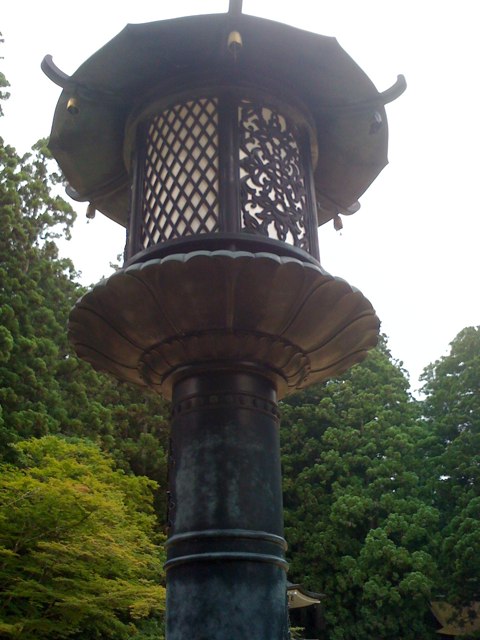
there were two glowing lamps that had golden dragons curled around the base. Behind those were two more lamps that were mostly covered by metal so that the designs in the metal seemed to glow on their own. One design that captured my attention was a circle with two wavy lines down the center, it was faintly reminicent of a three-sided ying-yang symbol. We found out later it stood for Universal Assistance.
There were three monks and after we were seated with the other guests, they began chanting. It was a captivating, slightly haunting sound that filled the room. The monks chanted for about 45 minutes using a large copper bowl that sounded like a bell when it was struck with a soft mallet, and a pair of cymbals that were crashed together at specific times during the chant.
It was interesting and quite beautiful to listen to. The only problem was the guests. A family came in after the ceremony had begun, and had to sit on the floor. They had brought their cameras and whispered and took photos the entire time. At one point one of the girls took a photo with a flash! The family was American and it made me embarrassed that I share the same nationality with them. I mean, would you go to a church and talk and take pictures while the priest is giving his sermon?! (For further ranting, please see the previous post "Are you a loud, rude American?")
After the ceremony, we ate breakfast (more rice and vegetables) and left to walk the town. Right next to our temple is the town graveyard. Many of the most important people in Japanese Buddhism are buried here along with many people from the town and surrounding area. After 1200 years, you can imagine how big it is. From the first bridge (where locals believe that the spirit of Kobo Daishi greets you and walks with you if you bow before crossing the bridge) to the end of the path, where a temple dedicated to Kobo Daishi sits, is a 2 kilometer walk. The graves lie in the mists of a forest of huge cedar trees, most of them well over 100 feet tall.
We had rented audio-guides from the local tourist office and learned much about the people buried in the graveyard. There is a lot of history there. The graves themselves are very ornate, and many have elaborate carvings and inscriptions.

At the end of the path, as I mentioned, there is a temple that supposedly sits in the place where Kobo Daishi sat and meditated before deciding that Koya was where he wanted to build his temple. It is small by temple standards, but it is considered the most spiritual place in Koyasan. Behind the temple there are a pair of candle lamps that have been continuously burning for over 1000 years. It's setting in the forest gives it a reverant sense about it.
From there we took the bus back into town to visit the rest of the major sites. We went to the Kongobuji Temple next. Kongobuji was built in 1593. After being rebuilt twice, the two temples on the site were combined. This temple still houses some administrative facilities for the local Shingon monks. The building is large with many rooms whose walls were covered in beautiful paintings. There is one room, called Jodan-No-Ma that was used for visiting dignitaries, and had a small room off to the side to house bodyguards in case of an attack.


There is a bit of a morbid side to this temple, however. The founder, Toyotomi Hidetsugu committed ritual suicide in the Willow Room when he felt that he had failed in his duties. It is a strange feeling to stand in a room where someone killed themselves 400 years earlier.

After Kongobuji, we went to Daishi Kyokai. We thought at first that it was just another temple, and we sat by the door for a moment and enjoyed the peace and smell of insence. Connected to the temple, however, was an education center that shows people more about the Buddhist religion. There was an option to receive a charm and the "Ten Good Precepts" or Ju-Zen-Kai from one of the resident monks. It sounded interesting, so I said okay, with Anna reluctantly following. It turned out to be the same initiation ceremony that is used for new monks. We were led into a dark room, heavy with the scent of incense, and joined in a chant. At the end, we were called up to the front, one by one, and received a charm from the lead monk. I'm not sure, but I think Anna and I have been initiated into the Buddhist religion.
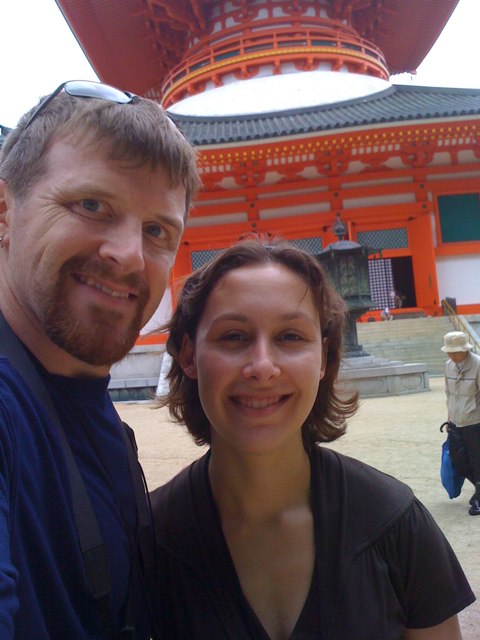
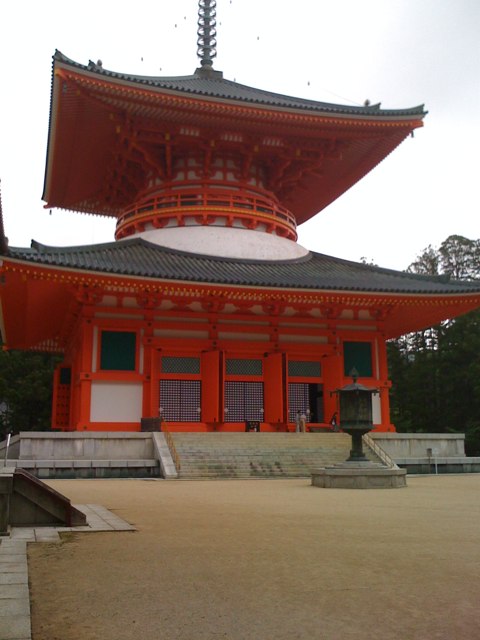
After leaving a little dazed and confused, and with sore knees and ankles from kneeling for so long, we moved on to Dai Garan, the original site of the first temple built in Koyasan. There are two main temples there that we visited, the Golden Hall - Kondo, and The Great Stupa - Daito. They are both impressive buildings. Daito is 50 meters high and 30 meters wide. They both have large and ornate shrines inside. Each building has also been burned down (either by accident or lightning strike) and rebuilt several times. The last time, the builders decided to reinforce Daito with concrete to help prevent it from happening again.


After visiting the temples, Anna found a new friend. A stray dog began following her around the grounds. He was a small mutt and seemed friendly, though he was pretty skittish around other people. There was something about Anna he liked, maybe he knew she was a vet.


We walked down the street after that and saw the main gate to the city, Daimon. It is another very impressive structure. Bright orange with two guardian statues at the base. We enjoyed the site for a moment and then walked back. On the way to the gate we had stopped at a store and bought a premade dinner of fried chicken, noodles, and greens. We walked back to Dai Garan and found our little friend again. When he first saw us, he wasn't very interested, but as soon as I brought out the food, his ears perked up and he came leaping down the wall he was laying on. We opened the plastic tray the dinner was in and put it on the ground. I don't think he even chewed once before swallowing. That and the bottle of water we gave him were probably the only food he'd seen in a while. After saying goodbye, we made our way back to our temple for dinner.
The following morning (this morning) the ceremony was a little different. We took part in it. There was a Japanese couple staying at the temple who wanted to pay respects to their family members who'd passed away. After they went up to the alter and bowed and lit an incense, each person there went up and did the same. We each sprinkled a bit of dust on the insence and bowed. I'm glad we were able to take part. (I had a few more reservations. We weren't asked or warned about participating. I was quite surprised by suddenly being forced to pray in front of four monks. We are only guessing that someone had passed away. -Anna)

After breakfast we took a short nap to prepare for the long journey we'll have over the next two days to Uepi in the Solomon Islands. We took the cable car back down the mountain and got on the train to Osaka, where we switched to the Bullet Train to Tokyo. And here we sit.
So this is it. Here's where the real adventure begins. From Uepi we'll go to Australia to go diving. We may not have much access to Internet from here. We might be able to sort the blog out in Sydney, but most of the time we probably will be posting madly anytime we get to a wi-fi spot. At the earliest we won't be able to post for probably another two weeks. Wish us luck. I am reminded of a quote from The Lord of the Rings. It goes something like this:
"You have to carefull, Frodo my boy, when stepping out your front door. If you don't keep your feet about you, you never know where you might be swept off to." - Scott

Thursday, July 9, 2009

Ryokan Night (hers)


Scott was very gentle in his description of the ryokan. It certainly was beautiful. However, I think sometimes the anticipated experience of an old, romantic tradition is more appealing than the reality. This was just such an occasion, the more to my dismay for my love of everything else Japanese.
Firstly, we had tried to reach the ryokan by taxi, due to being on the verge of a late check-in. We hailed a cab, only to be rejected because the destination was within 15 minutes walk. So we ran, with our baggage, and arrived only 3 minutes late, but drenched in sweat. I was now thoroughly irritated. We got to our room only to find that tatami mats absorb smells, and we were expected to walk around barefoot like the thousands before us. Gross. I felt the sudden and pressing urge to wash my feet, so we reserved bath time. The staff felt it neccessary to announce to us that we would be bathing together right in front of a large family with young children. Very embarrassing.
When you bathe Japanese style, you shower first, then soak in a (usually communal) bath tub. Ours was basically a wooden box filled with scalding water. I had to refill a fifth of it with cold water and even then I couldn't bear to stay in long. Even more annoying was the depth; sitting properly I was so far submerged that I had to tilt my head back to keep my nose above water. Not the comforting, luxurious bath I had envisioned. Then, I became so entangled in my yukata that the waitress laughed at me, and I ended up looking like a sack of potatoes. My dress-up like a geisha moment ruined, we waited for dinner.
Dinner was pretty rough. It was "small" food, just 3-4 bites of any one thing, and all dishes had a very strong odor of rotting fish. Scott curses my inability to reign in my overriding aversion to smells, but I remind all you viewers that this instinct was what helped our Neanderthal ancestors decide what foods were safe. I can't help it, when I smell something dead, I can't eat it. I picked through what I could, and since Scott really didn't like it much either, I resorted to hiding food under garnishes and pouring things down the sink to make it look like I ate. I ate barely 2 tablespoons of food until dessert, where I was able to eat two whole slices of melon. After a cube of corn jelly and 2 sips of eel broth, it was a feast.
The evening was finally over, and we were exhausted from the emotional strain of pretending to like everything and always being uncertain as to protocol. Strangely, as disappointed as I was while it was happening, I now (2 days later) am glad I tried it. There is a saying which I think fits here: vacations are anticipated with relish, experienced with annoyance, and recalled with fondness. -Anna

Wednesday, July 8, 2009

Ryokan Night (His)


We speant last night at a Ryokan in the middle of Kyoto. A Ryokan is a traditional garden hotel where you eat dinner, sleep and eat breakfast in one room. The building in which we we staying was 190 years old. It was a beautiful house that lookes like it could have come straight off the set of ""The Last Samuri".
Above, you can see Anna sitting at our table. The décor was authentic Japanese with tatami rice mat floors and low tables. After we checked in and were shown to our room, we made a reservation for the baths. Traditionally, bathing is done in public baths in Japan, but this Ryokan was used to western modesty, and allows people to set times where they can bathe in private. After our baths, we put on our yukatas (Japanese bathrobes) and waited for dinner.


Dinner was a bit of a struggle, less for me than for Anna. The menu was set, consisting of no less than ten courses, most of which was seafood. There were several dishes of sushi and sashimi. It was not quite as good as some we'd had, but still, not horrible. Though the raw squid was a little tough to get down. There were also some cooked dishes like grilled sweet fish, boiled abalone, and sauteed octopus. There was also a tempura dish with fried foie gras of all things. (I am slightly surprised at how much influence the French have had on Japan. There seems to be a French bakery on every corner.).
After each course, a kindly old lady would come in and replace our dishes with new ones. Throughout, she would point and rattle away in Japanese about which foods should be dipped in what sauces, and how to eat them.
After getting through most of the courses, with Anna trying to get me to eat hers so we wouldn't insult the chef by not eating, we were relieved to see that desert was simply fruit.
Dinner took nearly two hours to eat, and we were nearly exhausted by the time we were done. Two ladies came in, took the table away an pulled two thin mattresses out of the closet and laid them on the floor with some blankets and pillows. We were happy to settle in, read our books and enjoy the silent comfort of an old house.

The next morning, the process was reversed. The beds taken away and replaced by the table. We ate breakfast (thankfully a western breakfast of eggs and cereal), got packed up and checked out. Then we made our way through several trains and one old cable car to Mt. Koya, where I write this now. We are staying in a Buddhist temple on a mountain. It is beautiful here, and, thankfully, the menu will be entirely vegetarian.

Tuesday, July 7, 2009

The many cuisines of Japan


Robatayaki, a Japanese do-it yourself indoor grilling restaurant.
Sushi. Okay, we forgot to take a picture of the actual food, but you get the idea. The sushi here is fantastic.
Shabu-shabu. Together with sukiyaki, these two methods are basically Japanese fondue. You throw veggies, noodles, and rice cakes into the pot and let them simmer into you fish them out with chopsticks when they're done. Meat is cooked by swishing a piece in the broth while counting to 3. I must tell you that rice cakes and rice balls have a very strange consistency. Like gummy dough with no taste, you can chew it for hours and not be able to break it down.
A meal of soba noodles and rice balls. In the noodle bowl are two white fish cakes and two brown tofu cakes, and on the side are "pickles" and rice. The noodles are very slippery and rubbery but taste pretty good despite the texture. You will never get me to eat pickles of any kind.
More to come, we still have several days to go. Other common meals here are tempura, teppanyaki (hibachi grill style, SO much better than in the U.S.), and various rice casseroles. Check back. -Anna